
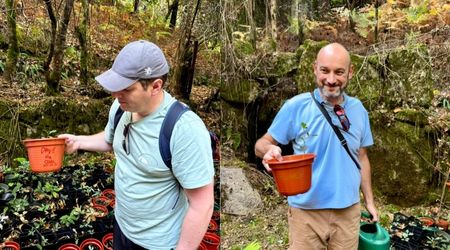
With every tour we offer, we plant a tree. While many companies outsource their carbon offsetting to distant projects, we believe in doing the work ourselves — right here in the Peneda-Gerês National Park. That’s why we organise communal planting days, where we, the guides, get our hands dirty: collecting, growing, and planting native trees to restore the forest.
From Hike to Habitat: Our Reforestation Process
Each autumn, while hiking through the mountains, we collect seeds and fruits from native species such as English oaks (Quercus robur) and sweet chestnuts (Castanea sativa). These are trees that belong to this region — they’ve evolved here for thousands of years.
Once sprouted, we nurture the seedlings through every stage of growth: carefully repotting them into larger containers, renewing the soil, and sheltering them under bigger trees to protect them from harsh sun or frost. It’s a team effort involving everyone who joins us — watering, tending, and watching them grow until they are strong enough to be returned to the wild.


Why Native Trees Matter in Portugal’s Forests
Native trees are cornerstones of the ecosystem. Take the Eurasian jay, for example: each autumn it collects hundreds of acorns, hiding them across the forest as winter stores. Many of these are forgotten, and eventually sprout into new oak trees — a form of natural reforestation.
Chestnut trees produce food for red squirrels, wild boar, and many forest birds. Below the surface, they partner with mycorrhizal fungi, forming underground networks that exchange water and nutrients — a mutual support system that helps forests thrive.
In spring, pollinators like mason bees and hoverflies depend on the flowers of native shrubs and trees. These insects, in turn, feed local bird species such as the firecrest and crested tit. These relationships — evolved over millennia — can’t function without native flora.
The Problem with Foreign Trees
Every year, wildfires destroy large areas of the national park. And while reforestation is urgently needed, it must be done responsibly. Unfortunately, many fast-track efforts rely on non-native species like eucalyptus and mimosa — and they do more harm than good.
Eucalyptus, originally from Australia, grows quickly but drains the soil, lowering groundwater levels and drying out the land. Its leaves release flammable oils, making forests more prone to ignition and harder to control once a fire starts. It also releases allelopathic chemicals into the soil, which suppress native plant growth.
Mimosa (Acacia dealbata) forms dense, fast-growing thickets that shade out understory plants, disrupt natural water cycles, and offer no value to local insects, birds, or mammals. In many areas, streams and springs have dried up where these trees dominate.
Together, these species outcompete native trees, degrade biodiversity, and weaken the forest’s resilience — turning rich ecosystems into monocultures.
Nature’s Own Defense System
Native trees, in contrast, help stabilize the landscape. Their deep roots anchor the soil, reducing erosion on steep slopes. After heavy rains, they absorb excess water, slow runoff, and recharge aquifers, supporting both land and water systems.
Even the leaf litter of native trees enriches the topsoil with organic matter, feeding fungi, microbes, and insects — the very foundation of a healthy forest. In regions like Peneda-Gerês, where climate extremes are intensifying, this natural infrastructure is irreplaceable.


Why We Reforest — and How You Can Help
Restoring native forest is not fast, and it’s not flashy. But it’s essential. These trees grow slower than eucalyptus, but they heal the land, support biodiversity, and bring balance back to the ecosystem.
With the help of our community and visitors, we’re working to reforest the right way — by giving native trees a chance to reclaim their place. Every seed we plant is a quiet, hopeful gesture toward a healthier forest.
So, when you are coming on a tour with us, you automatically contribute to keeping our native ecosystem alive as we each plant a tree together! You’re not just exploring nature — you’re helping it grow back.
